Reading the Rake: How a Premium Slot Tournament Buy-In Is Really Split
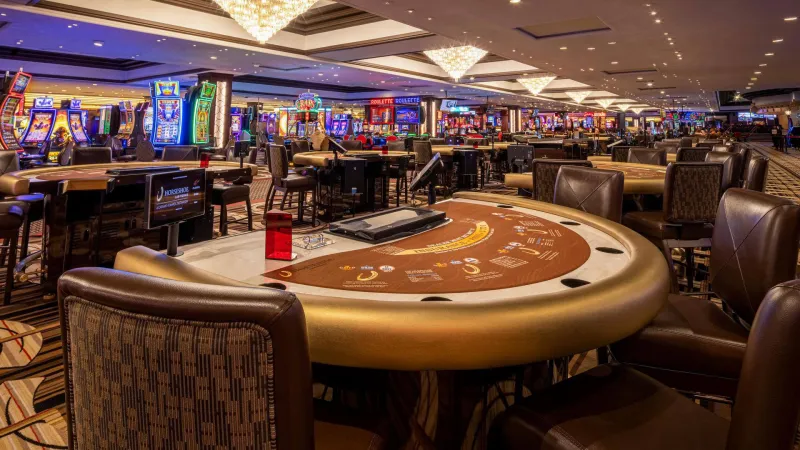
Photo: casino slot tournament floor with leaderboard screens and players, via www.casino.org
Slot tournament marketing tends to advertise two figures: the buy-in and the prize pool. Everything that sits between them — the house fee, the host budget, the guarantee that may or may not be funded — is usually left for the fine print. That gap is where players lose money they did not intend to risk.
This is an exercise in pricing, not prediction. Tournament slots are not a game you can beat with strategy; the reels are fixed and the field is finite. What a player can control is the quality of the event they enter. The tool for that is arithmetic.
The Four Buckets Every Buy-In Fills
Strip away the branding and a tournament budget almost always divides into four components.
The prize pool is the money returned to players. It is the only bucket that comes back through the field, and its size relative to total entries is the single most important number on the page.
The house fee is the operator's compensation for running the event. In a cash competition this functions exactly like a rake in poker: a fixed percentage skimmed before anyone is paid. It is legitimate, but it should be disclosed.
Host and venue costs cover the floor staff, the tournament desk, food and beverage, printed leaderboards, and whatever hospitality the event promises. Larger properties sometimes absorb this into their marketing budget; smaller ones bury it in the entry fee.
Overlay is the shortfall the operator agrees to cover when entries fail to fill the guarantee. Overlay is not free money in a moral sense — it is a marketing expense — but for the player it is the closest thing to positive expected value that a slot tournament offers.
A $50 Weeknight Event
Picture a midweek bracket at a regional property: 100 entries at $50, $5,000 collected, a published guarantee of $4,000.
- Prize pool paid out: $3,500 (70 percent of entries)
- House fee: $1,000 (20 percent)
- Host and venue: $500 (10 percent)
- Overlay: zero — entries exceeded the guarantee
An equally skilled field of 100 means each seat is worth roughly $35 in expected payout against a $50 cost. That is a 30 percent rake, which is steep by any standard. The event may still be enjoyable, but it is not a value proposition; it is entertainment with a known price.
A $500 Signature Event
Now a weekend headliner with a $40,000 guarantee and a $500 buy-in.
- Entries sold: 70 — $35,000 collected against a $40,000 guarantee
- Prize pool paid out: $40,000 (including $5,000 of operator overlay)
- House fee: $6,000 (roughly 15 percent of gross entry)
- Host and venue: $2,900
Here the math tilts the other way. Because the guarantee was not met, the operator absorbed a shortfall, and the effective return to the field exceeded 100 percent of collected entry money. A player who entered early captured real value; a player who entered a sold-out version of the same event two months later, at 110 entries, would have received the same $40,000 against $55,000 collected — a very different deal at the identical advertised price.
That is the central lesson of overlay: the same tournament can be excellent or mediocre depending on turnout, and turnout is knowable before you pay.
A $2,000 High-Roller Invitational
At the premium end, rakes compress. A 50-seat invitational at $2,000 per seat collects $100,000.
- Prize pool: $85,000 (85 percent)
- House fee: $10,000 (10 percent)
- Host, hospitality, and travel credits: $5,000 (5 percent)
High buy-ins carry thinner margins because the operator is competing for a small pool of players who compare notes. The trade-off is that premium events are also where the fine print gets creative: mandatory re-buys that inflate the pool, invitation-only qualifiers that consume part of the guarantee, and hospitality credits counted as prize value even though they cannot be withdrawn.
Signals of a Well-Funded Event
After reviewing dozens of tournament structures, the same markers recur among events worth the entry fee.
- A published payout table showing how many places pay and what percentage each receives. A top-heavy structure with three paid places out of 120 entrants is a lottery, not a tournament.
- A guarantee stated in dollars, not adjectives. Watch for language such as up to or based on a full field.
- A disclosed rake. If the operator will not say what percentage of entries reaches the prize pool, assume the worst and price accordingly.
- Clear rules on re-buys and add-ons. Unlimited re-buys favor the operator and the deepest wallet at the table.
- A stated round count and spin structure. Variance should be bounded; players deserve to know how many rounds decide the outcome.
- Separate accounting for non-cash prizes. Merchandise, cruises, and free play are frequently valued at retail rather than at what they are worth to you.
Running Your Own Expected Return
The formula is unglamorous: divide the total prize pool by the number of entries, then subtract the buy-in. If a $500 event guarantees $40,000 across 100 seats, each seat is worth $400 in expectation and the player is paying a $100 premium for the experience. That premium may be fair — for the hospitality, the field, the structure — but it should be a decision, not a surprise.
Players should also adjust for their own edge. In a field of casual entrants, a disciplined player who understands the scoring rules gains marginally; against a field of traveling tournament regulars, the same player is paying for the privilege of losing slowly.
Before You Hand Over the Card
Ask four questions at the tournament desk: How many entries are sold, what is the exact prize pool, what percentage of entries does the house retain, and what happens to the guarantee if the field does not fill. An operator who answers all four in writing is running a professional event. An operator who deflects is telling you where your money is going.
Slot tournaments are a legitimate and genuinely entertaining format, and the best ones treat their players like adults who can read a spreadsheet. Bring the spreadsheet.